Training compute, disclosed cost and release decisions for 540 notable AI models
from Epoch AI, and the 6 training-compute thresholds written into law or policy.
Doubling time of frontier training compute
Fitted by this site to Epoch's compute figures, not a figure Epoch publishes. Only the models that set a new record enter the fit, which is a small number of points. Starting the window at 2012, 2018 or 2020 instead gives 5.2, 5.0 and 5.2 months, so the answer is not an artefact of where the window starts.
Notable AI Models
Epoch AILicenceCC-BY-4.0UpdatedweeklyRetrieved
, today
Inclusion is editorial ("notability criteria"), not exhaustive. Compute figures are frequently estimates; check the per-row confidence and notes columns before treating any value as measured.CiteEpoch AI, "Notable AI Models". https://epoch.ai/data/ai-models. Retrieved 28 October 2026 via AI Safety Tracker, https://aisafetytracker.org/capability/.
6months
Least squares on the largest run to date, 2015 onward. A description of what happened, not a projection.
Largest reported training run
Notable AI Models
Epoch AILicenceCC-BY-4.0UpdatedweeklyRetrieved
, today
Inclusion is editorial ("notability criteria"), not exhaustive. Compute figures are frequently estimates; check the per-row confidence and notes columns before treating any value as measured.CiteEpoch AI, "Notable AI Models". https://epoch.ai/data/ai-models. Retrieved 28 October 2026 via AI Safety Tracker, https://aisafetytracker.org/capability/.
9.4e26FLOP
GPT-6 Astra, OpenAI, 2026-09-03.
Models released with open weights in 2025
Accessibility is unrecorded for a substantial minority; those are counted separately, not as unreleased.
Notable AI Models
Epoch AILicenceCC-BY-4.0UpdatedweeklyRetrieved
, today
Inclusion is editorial ("notability criteria"), not exhaustive. Compute figures are frequently estimates; check the per-row confidence and notes columns before treating any value as measured.CiteEpoch AI, "Notable AI Models". https://epoch.ai/data/ai-models. Retrieved 28 October 2026 via AI Safety Tracker, https://aisafetytracker.org/capability/.
42%
Of 107 notable models published that year. Weights are the one release decision nobody can reverse.
Models at or above the EU systemic-risk compute threshold
Counted from models with a reported or estimated compute figure. Many values are estimates.
Notable AI Models
Epoch AILicenceCC-BY-4.0UpdatedweeklyRetrieved
, today
Inclusion is editorial ("notability criteria"), not exhaustive. Compute figures are frequently estimates; check the per-row confidence and notes columns before treating any value as measured.CiteEpoch AI, "Notable AI Models". https://epoch.ai/data/ai-models. Retrieved 28 October 2026 via AI Safety Tracker, https://aisafetytracker.org/capability/.
24
Article 51 of the AI Act sets it at 1e25 FLOP, the lowest of the three compute thresholds currently in force.
Models at or above 1e26 FLOP, the Californian threshold
Counted by this site from Epoch's compute figures against the threshold written in the instrument. Not a legal finding about any model.
Notable AI Models
Epoch AILicenceCC-BY-4.0UpdatedweeklyRetrieved
, 5 days ago
Inclusion is editorial ("notability criteria"), not exhaustive. Compute figures are frequently estimates; check the per-row confidence and notes columns before treating any value as measured.CiteEpoch AI, "Notable AI Models". https://epoch.ai/data/ai-models. Retrieved 23 October 2026 via AI Safety Tracker, https://aisafetytracker.org/capability/.
Compute Threshold Index
This siteLicenceMITUpdatedquarterlyRetrieved
, 5 days ago
DataJSONCSVTraining-compute thresholds written into law, executive action or published policy, with the text that sets each one. Whether a given model crosses a threshold here is arithmetic on Epoch's compute estimates, most of which are estimates rather than disclosures, and is not a legal finding about any model or developer.CiteAI Safety Tracker, "Compute Threshold Index". https://aisafetytracker.org/capability/#thresholds. Retrieved 23 October 2026.
4
SB 53 applies to frontier developers above this line. 3 compute thresholds are in force anywhere in the world.
1e25 24
1e26 4
1e26 4
1e26 (revoked)4
1e26 (vetoed)4
1e26 (enacted)4
Training compute over time
Every notable model with a reported or estimated training-compute figure, on a
logarithmic scale. Each step of the axis is ten times the one below it.
Reported model
Largest run to date
EU systemic-risk threshold
468 models published 2012 onward with a compute figure.
Notable AI Models
Epoch AILicenceCC-BY-4.0UpdatedweeklyRetrieved
, today
Inclusion is editorial ("notability criteria"), not exhaustive. Compute figures are frequently estimates; check the per-row confidence and notes columns before treating any value as measured.CiteEpoch AI, "Notable AI Models". https://epoch.ai/data/ai-models. Retrieved 28 October 2026 via AI Safety Tracker, https://aisafetytracker.org/capability/.
Compute figures are frequently estimated rather than disclosed, and Epoch marks its own
confidence on each. Faded points are the ones marked speculative. Models whose compute is
unknown are absent entirely, which biases the picture toward labs that publish. Treat
anything near the threshold line as indicative, never as a legal finding about a
particular model. Epoch's own interactive version of this chart is at
epoch.ai/data/notable-ai-models.
What the training runs cost
Disclosed or estimated cost of the final training run, in 2023 dollars, for the 178
models where a figure exists. Also logarithmic.
Cost is known for 178 of 540 models with a compute figure, so this
is a sample of the disclosed, not a census of the spent. It counts the final training run
only: not the failed runs before it, not the staff, not the data, not the cluster sitting
idle between runs. The most expensive here is Grok 4 at $388m.
Notable AI Models
Epoch AILicenceCC-BY-4.0UpdatedweeklyRetrieved
, today
Inclusion is editorial ("notability criteria"), not exhaustive. Compute figures are frequently estimates; check the per-row confidence and notes columns before treating any value as measured.CiteEpoch AI, "Notable AI Models". https://epoch.ai/data/ai-models. Retrieved 28 October 2026 via AI Safety Tracker, https://aisafetytracker.org/capability/.
How models ship
Notable models by publication year and how they were made available: Open weightsA release in which the trained parameters are distributed and can be run by a third party. It does not imply an open-source licence, and the licence attached to a given release may restrict use.Glossary entry,
API accessA release in which a model can be queried over a network but its weights are not distributed. One of three release types recorded for notable models.Glossary entry, or never released.
1 Open weights in 20171 API only in 201724 Unreleased in 201729 Not recorded in 2017
17
9 Open weights in 20181 API only in 201820 Unreleased in 20187 Not recorded in 2018
18
31 Open weights in 201937 Unreleased in 2019
19
28 Open weights in 20201 API only in 202021 Unreleased in 2020
20
41 Open weights in 20219 API only in 202129 Unreleased in 2021
21
41 Open weights in 202213 API only in 202236 Unreleased in 20221 Not recorded in 2022
22
59 Open weights in 202324 API only in 202336 Unreleased in 2023
23
39 Open weights in 202443 API only in 202416 Unreleased in 2024
24
45 Open weights in 202555 API only in 20257 Unreleased in 2025
25
29 Open weights in 202653 API only in 20264 Unreleased in 20263 Other in 2026
26
Open weights
API only
Unreleased
Other
Not recorded
Notable AI Models
Epoch AILicenceCC-BY-4.0UpdatedweeklyRetrieved
, today
Inclusion is editorial ("notability criteria"), not exhaustive. Compute figures are frequently estimates; check the per-row confidence and notes columns before treating any value as measured.CiteEpoch AI, "Notable AI Models". https://epoch.ai/data/ai-models. Retrieved 28 October 2026 via AI Safety Tracker, https://aisafetytracker.org/capability/.
Notable model releases by year and accessibility class.
Year
Open weights
API only
Unreleased
Other
Not recorded
Total
2026
29
53
4
3
89
2025
45
55
7
107
2024
39
43
16
98
2023
59
24
36
119
2022
41
13
36
1
91
2021
41
9
29
79
2020
28
1
21
50
2019
31
37
68
2018
9
1
20
7
37
2017
1
1
24
29
55
The current year is partial and will fill in. "Not recorded" is its own column on purpose:
folding it into "unreleased" would turn a gap in the record into a claim that a model was
never released, which is a much stronger statement than the data supports.
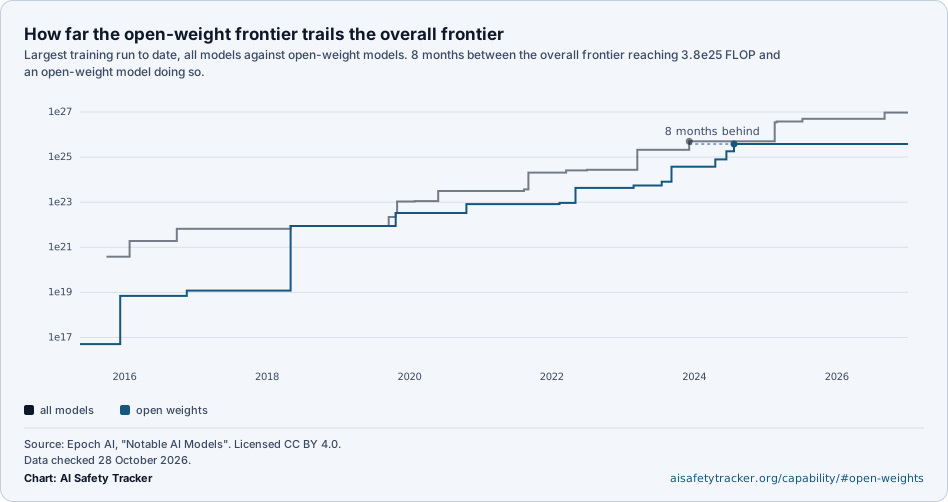
How far behind the open-weight frontier is
Largest training run to date over all models, against the same over models released
with open weights. Both are Running maximumThe highest value recorded up to each date. It rises or holds level and never falls, so a line fitted through one cannot slope downward.Glossary entry, so neither line can fall.
8 months
between the overall frontier reaching 3.8e25 FLOP and
an open-weight model doing so
Measured horizontally: the date the open-weight record was set, minus the date the first model of any kind reached that compute level. Computed by this site from Epoch's figures.
Notable AI Models
Epoch AILicenceCC-BY-4.0UpdatedweeklyRetrieved
, today
Inclusion is editorial ("notability criteria"), not exhaustive. Compute figures are frequently estimates; check the per-row confidence and notes columns before treating any value as measured.CiteEpoch AI, "Notable AI Models". https://epoch.ai/data/ai-models. Retrieved 28 October 2026 via AI Safety Tracker, https://aisafetytracker.org/capability/.
27 months
since the open-weight record last moved, set by Llama 3.1-405B
25x
more compute in GPT-6 Astra than in the largest open-weight model
15
times the open-weight record has been broken since 2015
Largest training run to date, all models against open-weight models
Running maximum of training compute by publication date. Accessibility is Epoch's classification; models with no accessibility recorded are counted in the overall line and not in the open-weight one.
Notable AI Models
Epoch AILicenceCC-BY-4.0UpdatedweeklyRetrieved
, today
Inclusion is editorial ("notability criteria"), not exhaustive. Compute figures are frequently estimates; check the per-row confidence and notes columns before treating any value as measured.CiteEpoch AI, "Notable AI Models". https://epoch.ai/data/ai-models. Retrieved 28 October 2026 via AI Safety Tracker, https://aisafetytracker.org/capability/.
Notable AI Models
Epoch AILicenceCC-BY-4.0UpdatedweeklyRetrieved
, today
Inclusion is editorial ("notability criteria"), not exhaustive. Compute figures are frequently estimates; check the per-row confidence and notes columns before treating any value as measured.CiteEpoch AI, "Notable AI Models". https://epoch.ai/data/ai-models. Retrieved 28 October 2026 via AI Safety Tracker, https://aisafetytracker.org/capability/.2012 to 2027
all models
open weights
Use this figure
An SVG image of this figure, with its sources, date and address printed in it, linked to
this section. SVG file. All
embeddable figures.
<a href="https://aisafetytracker.org/capability/#open-weights"><img src="https://aisafetytracker.org/embed/open-weight-lag.svg" alt="Step chart of the largest training run to date for all AI models against open-weight models, with the lag between them in months, from AI Safety Tracker" width="948" height="502" loading="lazy" style="max-width:100%;height:auto"></a>
Both lines are running maxima, so a flat stretch means no larger run has been reported,
not that anything got smaller. The open-weight line counts only models Epoch records as
released with open weights and with a compute figure attached; a model with unrecorded
accessibility falls into the overall line and not this one, so the true open-weight
frontier can only be at or above what is drawn. Compute figures are frequently
estimates, and they arrive late: recent models with a compute figure attached are almost all
open-weight ones, because closed developers do not publish and an outside estimate takes
time, so the right-hand end of the overall line is a lower bound too. Training compute is
also not capability: a smaller, better-trained model can beat a larger one, which is the
main reason this gap has narrowed in benchmark terms faster than it has in FLOP.
Who builds them
Notable models published since 2023, by organisation and by the country of the
organisation that built them.
By organisation147 in total
Organisations by count of notable models published since 2023.
Organisation
Models
Relative magnitude
OpenAI
58
Google DeepMind
36
Alibaba
31
Anthropic
22
Meta AI
21
ByteDance
10
DeepSeek
10
Nvidia
9
xAI
9
Moonshot
8
Show the remaining 137
Organisations by count of notable models published since 2023. Rows 11 to 147.
Z.ai (Zhipu AI)
8
LG AI Research
7
Mistral AI
6
Tencent
6
Google
5
Apple
4
Baidu
4
01.AI
3
Character.ai
3
Google Research
3
Microsoft
3
MiniMax
3
Amazon
2
Cursor
2
Huawei
2
Inception Labs
2
Inflection AI
2
Kunlun Inc.
2
Meituan Inc
2
National University of Singapore
2
Nvidia,Massachusetts Institute of Technology (MIT)
2
Runway
2
SK Telecom
2
Stability AI
2
Technology Innovation Institute
2
Thinking Machines
2
Tsinghua University
2
Upstage
2
Writer
2
Xiaomi Corp
2
Z.ai (Zhipu AI),Tsinghua University
2
Adobe
1
AI21 Labs
1
Alibaba,Huazhong University of Science and Technology
1
Allen Institute for AI
1
Allen Institute for AI,University of Washington,National University of Singapore,University of Pennsylvania,Johns Hopkins University,Amazon,Cortex AI
1
Ant Group
1
Bloomberg,Johns Hopkins University
1
ByteDance,Nanyang Technological University,Chinese University of Hong Kong (CUHK),Hong Kong University of Science and Technology (HKUST)
1
ByteDance,Peking University
1
Carnegie Mellon University (CMU)
1
Carnegie Mellon University (CMU),Princeton University
1
Cerebras Systems,Mohamed bin Zayed University of Artificial Intelligence (MBZUAI),Inception G42
1
Chai discovery
1
China Telecom
1
Cognition
1
Cohere
1
Cohere Labs (formerly Cohere for AI),Brown University,Cohere,Carnegie Mellon University (CMU),Massachusetts Institute of Technology (MIT)
1
Columbia University,Apple
1
Databricks
1
DeepL
1
DeepMind,University of Toronto
1
ETH Zurich,Disney Research
1
EvolutionaryScale,University of California (UC) Berkeley
1
Facebook AI Research,INRIA
1
Facebook AI Research,University of Washington,University of California (UC) Berkeley,Carnegie Mellon University (CMU),Toyota Technological Institute at Chicago
1
Facebook,INRIA,University of California (UC) Berkeley
1
Generalist
1
Google DeepMind,Google Research
1
Google DeepMind,Google Research,Google Cloud
1
Google DeepMind,Isomorphic Labs
1
Google DeepMind,New York University (NYU)
1
Google DeepMind,University of California San Diego,Stanford University
1
Google Research,DeepMind
1
Google,Google DeepMind
1
Google,TU Berlin
1
Google,University of California Los Angeles (UCLA)
1
Harrison.ai
1
Huawei Noah's Ark Lab
1
Hugging Face,ServiceNow,Northeastern University,Mila - Quebec AI (originally Montreal Institute for Learning Algorithms),Carnegie Mellon University (CMU),Johns Hopkins University,Leipzig University,ScaDS.AI,Queen Mary University of London,Roblox,Sea AI Lab,Technion - Israel Institute of Technology,Monash University,CSIRO,Data61,McGill University,Saama,University of British Columbia (UBC),Massachusetts Institute of Technology (MIT),Technical University of Munich,IBM,University of Vermont,UnfoldML,SAP,University of Notre Dame,Columbia University,New York University (NYU),University of Allahabad,Discover Dollar,Toloka,Telefonica,Stanford University,Weizmann Institute of Science,Alan Turing Institute,Wellesley College,EleutherAI,Forschungszentrum Julich
1
Inspur
1
Intel Labs
1
King Abdullah University of Science and Technology (KAUST),Karolinska Institute
1
Korea University,Korea Advanced Institute of Science and Technology (KAIST),LG
1
Magic
1
Meta AI,Hebrew University of Jerusalem
1
Meta AI,Hebrew University of Jerusalem,LORIA
1
Meta AI,Stanford University
1
Microsoft,Microsoft Research
1
Motif Technologies
1
Nanjing University,Shenzhen Institute of Advanced Technology,Shanghai AI Lab
1
NAVER
1
NC AI
1
New York University (NYU)
1
New York University (NYU),University of California (UC) Berkeley
1
Nvidia,Massachusetts Institute of Technology (MIT),University of California (UC) Berkeley,University of California San Diego,University of Washington,Tsinghua University
1
Nvidia,Meta AI
1
Nvidia,Nanjing University,Tsinghua University,Hong Kong Polytechnic University,Johns Hopkins University,New York University (NYU)
1
Nvidia,Technical University of Munich,InstaDeep
1
Nvidia,University of Toronto,Vector Institute,University of Illinois Urbana-Champaign (UIUC)
1
OpenEvidence
1
Oppo Mobile Telecommunications
1
Perplexity
1
Physical Intelligence
1
Prime Intellect
1
Reka AI
1
rinna
1
Salesforce
1
Salesforce Research
1
Salesforce Research,Hong Kong University of Science and Technology (HKUST),Nanyang Technological University
1
Sapient Intelligence
1
Saudi Aramco
1
Saudi Data and Artificial Intelligence Authority
1
SenseTime
1
Shanghai AI Lab
1
Shanghai AI Lab,Chinese University of Hong Kong (CUHK),ShanghaiTech University
1
Shanghai AI Lab,SenseTime
1
Shanghai Qi Zhi institute,Stanford University,Carnegie Mellon University (CMU),Tsinghua University
1
Stability AI,University of Illinois Urbana-Champaign (UIUC)
1
Stanford University,CZ Biohub Network
1
Stanford University,Google Research,Georgia Institute of Technology
1
Stanford University,Harvard University,Mila - Quebec AI (originally Montreal Institute for Learning Algorithms),University of Montreal / Université de Montréal
1
Stanford University,Princeton University
1
Stanford University,Sony
1
Stanford University,University of California (UC) Berkeley,Toyota Research Institute,Google DeepMind,Massachusetts Institute of Technology (MIT),Physical Intelligence
1
StepFun
1
Suno
1
Technical University of Munich,Columbia University
1
TensorTour
1
Tsinghua University,BioMap Research
1
Tsinghua University,Nanyang Technological University,Carnegie Mellon University (CMU)
1
Tsinghua University,Tencent,Nanyang Technological University
1
Tsinghua University,University of Illinois Urbana-Champaign (UIUC),Shanghai AI Lab,Peking University,Shanghai Jiao Tong University,CUHK Shenzhen Research Institute
1
Tsinghua University,Z.ai (Zhipu AI)
1
Tsinghua University,Z.ai (Zhipu AI),Beihang University
1
University of California (UC) Berkeley,California Institute of Technology,University of Toronto,University of Wisconsin Madison,Texas A&M,Nvidia,Mila - Quebec AI (originally Montreal Institute for Learning Algorithms)
1
University of California (UC) Berkeley,Stanford University,Carnegie Mellon University (CMU),DeepMind
1
University of California Los Angeles (UCLA),Columbia University,New York University (NYU)
1
University of Minnesota,Grammarly
1
University of Southern California,Georgia Institute of Technology,Stanford University,Nvidia
1
University of Turku,Hugging Face
1
University of Washington,Seoul National University,University of Sheffield
1
University of Wisconsin Madison,Microsoft Research
1
University of Wisconsin Madison,Microsoft Research,Columbia University
1
Utrecht University
1
Westlake University,Tsinghua University,Toyota Technological Institute at Chicago
1
Zhuiyi Technology
1
By country of organisation17 in total
Countries by count of notable models published since 2023.
Country
Models
Relative magnitude
United States of America
251
China
117
South Korea
15
France
6
United Kingdom
4
Saudi Arabia
3
Singapore
3
Canada
2
Germany
2
United Arab Emirates
2
Show the remaining 7
Countries by count of notable models published since 2023. Rows 11 to 17.
Australia
1
Finland
1
Hong Kong
1
Israel
1
Japan
1
Netherlands
1
Switzerland
1
413 models published since 2023, of which 412 have a country
recorded. Country is the country of the organisation, not of the compute, the data or the
people. A multinational lab is counted once, at its listed home. Inclusion in Epoch's
database is editorial, so these are counts of what has been judged notable rather than of
everything built.
Notable AI Models
Epoch AILicenceCC-BY-4.0UpdatedweeklyRetrieved
, today
Inclusion is editorial ("notability criteria"), not exhaustive. Compute figures are frequently estimates; check the per-row confidence and notes columns before treating any value as measured.CiteEpoch AI, "Notable AI Models". https://epoch.ai/data/ai-models. Retrieved 28 October 2026 via AI Safety Tracker, https://aisafetytracker.org/capability/.
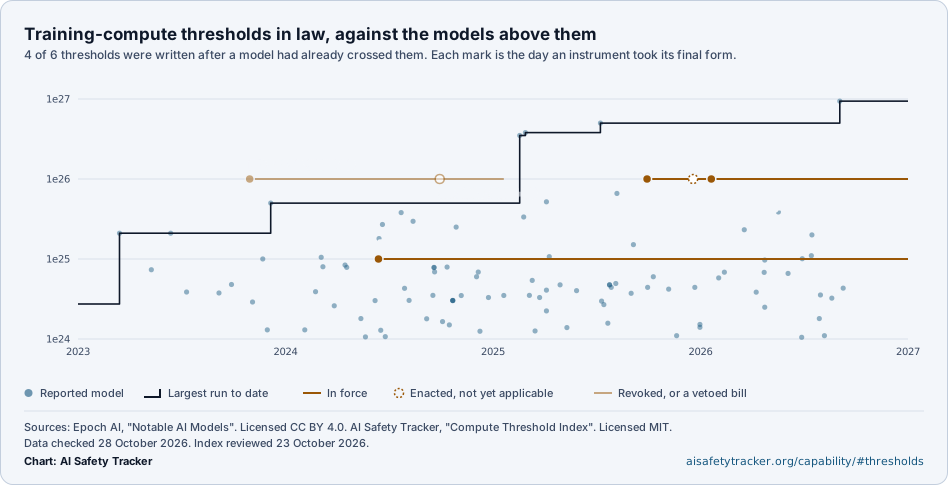
The compute thresholds written into law
Every Compute thresholdA quantity of training compute written into a statute, executive action or official policy document, above which additional obligations apply. Recorded here with the instrument that sets it and the number of models above it.Glossary entry set by a statute, an executive action or an official
policy document, the day each took its final form, and how many models with a
published compute figure sat above it that day and sit above it now.
4 of 6
thresholds written after a model had already crossed them
Compute Threshold Index
This siteLicenceMITUpdatedquarterlyRetrieved
, 5 days ago
DataJSONCSVTraining-compute thresholds written into law, executive action or published policy, with the text that sets each one. Whether a given model crosses a threshold here is arithmetic on Epoch's compute estimates, most of which are estimates rather than disclosures, and is not a legal finding about any model or developer.CiteAI Safety Tracker, "Compute Threshold Index". https://aisafetytracker.org/capability/#thresholds. Retrieved 23 October 2026.
Notable AI Models
Epoch AILicenceCC-BY-4.0UpdatedweeklyRetrieved
, 5 days ago
Inclusion is editorial ("notability criteria"), not exhaustive. Compute figures are frequently estimates; check the per-row confidence and notes columns before treating any value as measured.CiteEpoch AI, "Notable AI Models". https://epoch.ai/data/ai-models. Retrieved 23 October 2026 via AI Safety Tracker, https://aisafetytracker.org/capability/.
5
models already above 1e25 when the EU AI Act was signed, 13 Jun 2024
7 months
from the first model above 1e26 to the first 1e26 threshold in force
Reported model
Largest run to date
In force
Enacted, not yet applicable
Revoked, or a vetoed bill
Use this figure
An SVG image of this figure, with its sources, date and address printed in it, linked to
this section. SVG file. All
embeddable figures.
<a href="https://aisafetytracker.org/capability/#thresholds"><img src="https://aisafetytracker.org/embed/compute-thresholds.svg" alt="Timeline of the training-compute thresholds written into law and policy against the AI models with a published compute figure, from AI Safety Tracker" width="948" height="485" loading="lazy" style="max-width:100%;height:auto"></a>
Training-compute thresholds in law and policy, with the instrument that sets each,
its status, the day it took its final form, the models above it that day, the first
model to cross it, and the count of models at or above it now.
Applies to General-purpose AI models placed on the EU market
Consequence Presumption of systemic risk, bringing model evaluation, adversarial testing, incident reporting and cybersecurity obligations.
A rebuttable presumption rather than a hard line: a developer can argue its model does not carry systemic risk despite the compute, and the Commission can designate a model that falls below it.
Applies to Frontier developers training models above the threshold
Consequence Duty to publish a frontier AI framework and transparency report, and to report critical safety incidents to the state.
Counts the initial training run plus later fine-tuning and material modification, so it is a cumulative figure rather than a single-run one. Larger obligations attach above an annual revenue threshold as well.
Applies to AI systems trained with cumulative compute at or above the threshold that also apply state-of-the-art technology and pose wide and serious risk to fundamental rights
Consequence Duty to identify, assess and mitigate risks across the life cycle, run a safety-incident response system, and submit the results to the Ministry of Science and ICT.
Cumulative training compute, and the first of three conditions that must all hold, so crossing 1e26 alone does not bring a model into scope. In force from 22 January 2026 under the AI Basic Act, with fines deferred for a grace period of at least a year.
Applies to Developers of dual-use foundation models
Consequence Reporting of training runs, results of red-team testing and security measures.
The first compute threshold in any official instrument, revoked in January 2025. Included because it is still widely quoted as current, and because California later adopted the same number.
Applies to Frontier developers training models above the threshold, with the heavier duties on those with over $500 million in annual revenue
Consequence Duty to publish safety and security protocols and to report safety incidents to the state.
Signed in December 2025 and amended in March 2026 to track California's SB 53. It applies from 1 January 2027, so it is counted here as enacted rather than in force.
Six thresholds exist, five of them at 1e26, three in force, one enacted but not yet applicable, one revoked and one vetoed. Whether a model sits above a line is arithmetic on Epoch's compute figures, most
of which are estimates rather than disclosures, and the EU threshold is a rebuttable
presumption rather than a hard boundary. Nothing here is a legal finding about any model
or developer.
Thresholds are our own index of primary instruments. Model compute figures are Epoch's.
Compute Threshold Index
This siteLicenceMITUpdatedquarterlyRetrieved
, 5 days ago
DataJSONCSVTraining-compute thresholds written into law, executive action or published policy, with the text that sets each one. Whether a given model crosses a threshold here is arithmetic on Epoch's compute estimates, most of which are estimates rather than disclosures, and is not a legal finding about any model or developer.CiteAI Safety Tracker, "Compute Threshold Index". https://aisafetytracker.org/capability/#thresholds. Retrieved 23 October 2026.
Notable AI Models
Epoch AILicenceCC-BY-4.0UpdatedweeklyRetrieved
, 5 days ago
Inclusion is editorial ("notability criteria"), not exhaustive. Compute figures are frequently estimates; check the per-row confidence and notes columns before treating any value as measured.CiteEpoch AI, "Notable AI Models". https://epoch.ai/data/ai-models. Retrieved 23 October 2026 via AI Safety Tracker, https://aisafetytracker.org/capability/.
Benchmark scores, difficulty tiers and the rate at which tests are being solved have
moved to Progress.
Related
ProgressBenchmark scores for the models these training runs produced.
DatacentresThe sites that supply training compute, by power and owner.
Law and policyEleven jurisdictions' instruments, among them those that set the thresholds.